Learning how to budget your paycheck should not feel like trying to solve a complicated math problem.
You should not need ten spreadsheets, several apps, or a perfect financial life to make a plan for your money.
You need a simple routine that helps you see what is coming in, what needs to be paid, and what you can safely spend before your next payday.
If you get paid and feel hopeful for a day or two—but then start wondering where all your money went—you are not alone.
Bills come out. Groceries cost more than expected. You stop for takeout because you are tired. A child needs something for school. The car needs gas. Then an expense you did not plan for appears.
Suddenly, payday feels far away again.
That does not always mean you are careless with money. Often, it means your paycheck did not have a clear plan before the spending began.
A paycheck budget planner can help you slow down, look at the real numbers, and make one decision at a time.
You do not have to fix everything today. Start with your next paycheck.
Why Your Paycheck May Disappear So Quickly
Many traditional budgets are built around an entire month.
That can work for some people, but it can feel confusing when your bills and income do not arrive at the same time.
You may get paid every Friday, every two weeks, twice a month, once a month, or on an irregular schedule. Meanwhile, your rent, utilities, insurance, groceries, and other needs all have different due dates.
A monthly total does not always tell you which bill should come out of which paycheck.
That is why budgeting by paycheck can feel easier.
Instead of trying to control the whole month at once, you ask:
What does this paycheck need to do before the next one arrives?
That question gives you a smaller, clearer starting point.
Start Your Paycheck Plan With Prayer and Honesty
Christian budgeting is not about pretending that prayer will make every bill disappear.
It is also not about feeling ashamed when the numbers are difficult.
Prayer can help you slow down, face the truth, and ask God for wisdom before making decisions.
Before you begin your paycheck budget, take a quiet moment and pray something simple:
Lord, thank You for what You have provided. Help me look at my money honestly and make wise choices. Show me what needs to be paid first. Give me peace, discipline, and wisdom for my next step. Amen.
Then look at the numbers as they are—not as you wish they were.
Write down:
- The amount you expect to receive
- Your current bank balance
- Bills due before your next payday
- Food and transportation needs
- Any urgent expenses you already know about
You cannot build a clear plan around numbers you are avoiding.
Honesty is not failure. It is where change begins.
How to Budget Your Paycheck in Five Simple Steps
You do not need to complete dozens of worksheets every payday.
A useful paycheck budget can be created with five simple steps.
Step 1: Write Down Your Real Take-Home Pay
Start with the amount that will actually reach your bank account.
Do not use your gross income before taxes, insurance, or other deductions. Use your expected take-home pay.
Include every source of income arriving during this pay period, such as:
- Your regular paycheck
- Overtime
- Side work
- Child support
- Benefits
- Any other dependable income
If your pay changes from week to week, use the lowest amount you reasonably expect.
It is easier to adjust your plan when extra money arrives than to build a plan around money that may not come.
Step 2: List Bills Due Before Your Next Payday
This part is important: do not automatically list every bill for the entire month.
List the bills that need to be paid before your next paycheck arrives.
For example, imagine you are paid on May 1 and again on May 15.
Your first paycheck may need to cover:
- Rent due May 3
- Electricity due May 5
- Car payment due May 7
- Insurance due May 8
- Internet due May 10
A bill due on May 20 may belong in the plan for your next paycheck.
This helps you avoid using your first paycheck for expenses that could wait while forgetting something urgent that is due sooner.
Write the due date and amount beside each bill. Then mark it paid after the payment is made.
That simple action can reduce a lot of mental clutter.
Step 3: Pay What Matters First
When money feels tight, everything can feel urgent.
However, some expenses protect your safety and daily life more than others.
A simple order of priority may look like this:
- Housing and urgent safety needs
- Food, medicine, childcare, and transportation
- Utilities, insurance, and required minimum payments
- A small amount of money for surprises
- Extra savings and debt payments
- Wants and purchases that can wait
Your situation may be different, but the main idea is to protect the basics first.
This does not mean your savings or debt goals are unimportant. It means you should not make a large extra debt payment and then discover you cannot buy groceries or get to work.
Wise progress protects your home while helping you move forward.
Step 4: Create a Weekly Spending Plan
Bills are only part of your paycheck.
Everyday spending can quietly use the rest.
A weekly paycheck budget helps you decide how much is available for things such as:
- Groceries
- Gas or transportation
- Household needs
- Personal spending
- Eating out
- Small miscellaneous expenses
Suppose you have $300 available for two weeks of everyday spending.
Instead of thinking, “I have $300 left,” divide it into smaller limits.
You might plan:
- Week one: $150
- Week two: $150
Or you could separate it further:
- Groceries: $180
- Gas: $70
- Household or miscellaneous needs: $50
The exact numbers will depend on your income and household.
The point is to give the money a limit before it becomes a series of small, unplanned purchases.
Step 5: Review the Paycheck Without Shame
A paycheck budget is not finished when you write it down.
Before the next payday, look back and ask:
- What went well?
- Which bill was paid?
- Where did I spend more than planned?
- Is there any money left?
- What is one small change I can make next time?
Do not use your review to criticize yourself.
Use it to learn.
Perhaps you spent more on takeout because there was no easy food at home. Your next step could be planning two simple meals before payday.
Maybe gas cost more than expected. Your next plan can include a larger transportation amount.
Perhaps you stayed under your weekly limit. Celebrate that progress.
A budget should help you make better decisions—not make you feel worse about yourself.
Need a Simple Paycheck Budget Planner?
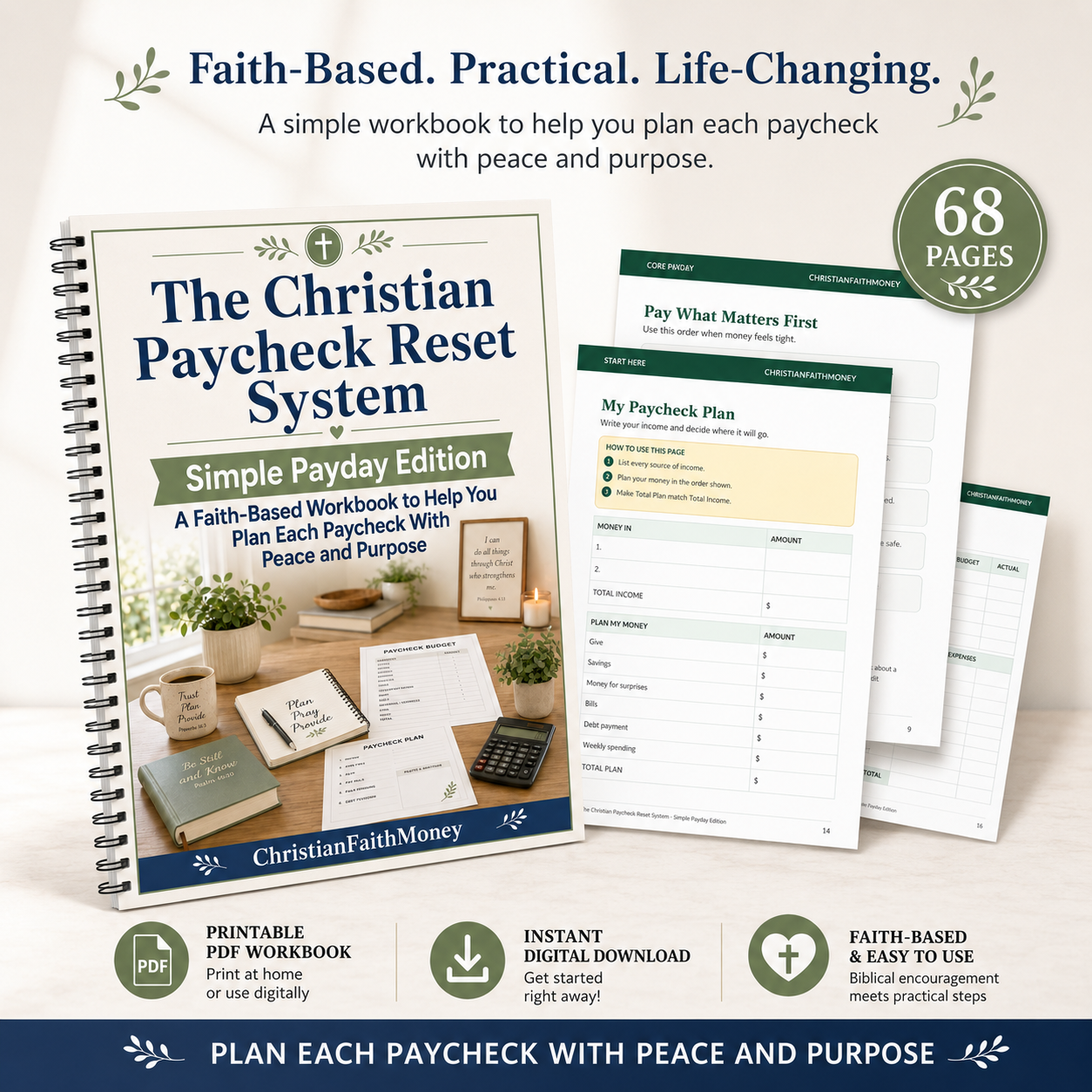
The Christian Paycheck Reset System was created for people who want clear instructions—not another stack of confusing blank pages.
This 68-page faith-based printable workbook gives you a simple five-page routine to use each payday:
- Payday Preparation Checklist
- Paycheck Plan
- Bills to Pay
- Weekly Spending Plan
- Payday Review
Each main worksheet includes a completed example before the blank page, so you can see exactly what to write.
You will also receive a 30-Day Money Reset, prayer and Scripture encouragement, and optional guides for overdue bills, surprise expenses, overspending, irregular income, debt, savings, groceries, and other real-life money problems.
Instant digital download • Printable PDF • Designed for US Letter paper
START MY PAYCHECK RESET
A Simple Paycheck Budget Example
Here is an example of how a $2,000 paycheck could be planned.
Your own numbers may look completely different. This example is only meant to show how every dollar can receive a job.
Total income: $2,000
- Giving: $100
- Savings: $100
- Money for surprises: $100
- Bills due before next payday: $1,200
- Groceries and gas: $350
- Extra debt payment: $100
- Personal spending: $50
Total planned: $2,000
Nothing is left floating around without a purpose.
That does not mean you need to spend all the money immediately. It means you know what each amount is supposed to do.
The savings money stays in savings.
The grocery money is available for groceries.
The bill money is protected for bills.
The money for surprises is there when an unplanned need happens.
This is the heart of a budget-by-paycheck system: every dollar has a job before everyday spending begins.
What Is “Money for Surprises”?
Many budgeting systems call this a buffer.
However, “money for surprises” may feel easier to understand.
This is a small amount set aside for expenses that were not in your original plan.
It might cover:
- A higher utility bill
- Medicine
- A school expense
- An unexpected transportation cost
- A household item that needs to be replaced
Without this category, one small surprise can throw off the entire paycheck.
You may not be able to set aside a large amount. Even $10 or $20 can be a beginning.
When you do not use it, you can leave it for the next paycheck or move it toward savings.
How to Budget a Biweekly Paycheck
A biweekly paycheck budget follows the same five-step process.
The biggest difference is that your money may need to cover two weeks of bills and everyday spending.
Begin by writing your next payday date.
Then list every bill due between this payday and the next one.
After the bills are planned, divide your food, gas, and miscellaneous money between the two weeks.
For example, if you have $400 for everyday spending, avoid treating the full $400 as available during the first week.
You could divide it like this:
- Week one spending: $200
- Week two spending: $200
Some months will include three paychecks instead of two. Do not automatically treat the extra paycheck as spending money.
Look ahead for:
- Next month’s rent
- Annual or irregular bills
- Car repairs
- Emergency savings
- Debt payments
- Upcoming holidays or school expenses
An “extra” paycheck can help you prepare for future needs.
What If Your Income Changes?
Irregular income can make budgeting feel uncertain, but you can still create a plan.
Start with the lowest dependable amount you expect to receive.
Use that amount to protect:
- Housing
- Utilities
- Food
- Transportation
- Insurance
- Minimum required payments
When extra income arrives, give it a job instead of spending it without a plan.
You may decide to use the additional money for:
- A bill due later
- Money for surprises
- Savings
- Debt
- An upcoming irregular expense
This approach can make your plan feel safer because it is not built around your best possible income month.
Common Paycheck Budgeting Mistakes
Trying to Fill Out Too Many Pages
More worksheets do not always create more clarity.
Start with the five core pages. Use optional worksheets only when they solve a specific problem.
For example, use an expense tracker when you do not know where your money is going. Use a debt page when you are working on a debt goal.
You do not need every tool every payday.
Forgetting Small Purchases
A few small purchases may not seem important, but they add up.
Coffee, convenience-store stops, app purchases, and takeout can quietly use money planned for something else.
You do not have to remove every enjoyable purchase. Add a realistic amount to your plan instead.
Creating a Plan That Is Too Strict
A budget that leaves no room for real life can be difficult to follow.
Include realistic food, transportation, and personal spending amounts.
Also include money for surprises when possible.
A plan should guide you, not punish you.
Giving Up After One Difficult Paycheck
One hard week does not mean the system failed.
Budgets need adjustments.
Your grocery amount may need to change. A bill may increase. Your income may be different.
Review the plan, make one change, and begin again with your next paycheck.
Christian Budgeting Is About Faithfulness, Not Perfection
Managing money as a Christian is not about proving that you are worthy of God’s help.
It is not about becoming wealthy overnight.
It is about learning to be honest, prayerful, wise, and faithful with what is in your hands today.
Some paychecks will feel easier than others.
Sometimes you will make progress. Other times, all you can do is protect the basics.
Both seasons require wisdom.
You can pray and still make a written plan.
You can trust God and still check your bank balance.
You can have faith and still call a company to ask about a payment arrangement.
Practical action does not replace faith. It can be part of faithful stewardship.
Build the Habit One Paycheck at a Time
You do not need to master budgeting in one month.
Begin with one paycheck.
Gather your numbers.
List what is due.
Plan your weekly spending.
Set aside what you can.
Review what happened.
Then repeat the process.
Over time, this routine can help you feel less surprised by your money and more prepared for payday.
You may still face difficult expenses. A paycheck plan cannot prevent every emergency or solve every income problem.
However, it can give you a clear next step when everything feels scattered.
That clarity matters.
Ready to Reset Your Next Paycheck?
The Christian Paycheck Reset System gives you the structure, examples, and encouragement to stop guessing and begin planning.
Inside the 68-page printable workbook, you will find:
- Five core payday worksheets
- Filled examples before the blank pages
- A 30-Day Money Reset
- Bill, spending, debt, and savings tools
- Help for irregular income and overdue bills
- Prayer and Scripture encouragement
- Optional Money Problem Guides
You do not need to complete all 68 pages.
Print the five core worksheets for your next payday. Keep the completed examples nearby. Then use the optional pages only when you need extra help.
[GET THE CHRISTIAN PAYCHECK RESET SYSTEM]
Instant digital download. Nothing will be mailed. This is a printable PDF designed to be completed by hand.
Start with prayer.
Make one clear plan.
Take one wise step.
Then do it again next payday.